



Winter in Florida is unique: nights can get chilly, but the rare frost is usually light, and daytime highs can still reach the eighties. Winter cover crops build organic matter, enhance nutrient cycling, and contribute to carbon sequestration. Incorporating them into a food forest can transform soil for healthier spring plantings.
Why winter cover crops matter in Florida
Florida soils are often sandy, low in organic matter, and prone to nutrient leaching due to heavy rains and high temperatures. Cover crops are living mulches that cover the ground during periods of dormancy. They can reduce soil erosion, suppress weeds, and improve water infiltration.

Nutrient cycling is another key benefit. Cover crops prevent runoff into waterways — a major issue in Florida’s aquifer-sensitive environment. Legumes fix nitrogen from the air, while deep-rooted varieties like radishes mine nutrients from subsoil layers. Let’s break down four Florida-friendly options.
These crops also play a pivotal role in carbon sequestration — the process of capturing atmospheric CO2 and storing it in the soil as organic carbon. Roots, shoots, and decaying plant matter add biomass, boosting soil carbon levels.

Perennial Peanut: The Low-Maintenance Soil Builder
Perennial peanut (Arachis glabrata) is a warm-season legume that’s gaining popularity as a winter cover crop in Florida, particularly in USDA Hardiness Zones 8b through 11 (most of the state south of Gainesville). Unlike annual peanuts, this rhizomatous perennial forms a dense mat that persists year-round, making it ideal for long-term soil improvement.
Planting and Management
Plant perennial peanut rhizomes or sprigs in late summer to early fall (August to October) for establishment before winter. It thrives in full sun and well-drained sandy soils, tolerating pH from 5.5 to 7.0. Space plants 12-18 inches apart in rows, or broadcast for ground cover. Initial watering is crucial, but once established, it’s drought-tolerant and itrogen-fixing.
In winter, perennial peanut goes semi-dormant in north Florida but remains green and active in central and south regions. Mow it to 3-4 inches to encourage spreading and prevent legginess. It took a while to establish, thanks to the rabbits, but patience pays off.
This winter, we’ve only had a low of 24 degrees and many days in the eighties, so my perennial peanut has stayed dense and green. In fact, I’ve been taking lots of cuttings to propagate it.
Benefits for Soil Health, Carbon Sequestration, and Nutrient Cycling
Perennial peanut excels at building soil structure. Its deep root system (up to 3 feet) penetrates compacted layers, improving aeration and water holding capacity — critical for Florida’s sandy soils that can hold less than 1% organic matter naturally.
For carbon sequestration, the plant’s extensive biomass contributes significantly. Research from the University of Florida shows perennial peanut can add 2-4 tons of dry matter per acre annually, much of which decomposes into stable soil organic carbon. This not only sequesters CO2 but also enhances microbial activity, creating a cycle of soil fertility.
In terms of nutrient cycling, as a legume, it partners with rhizobia bacteria to fix nitrogen. This eliminates the need for synthetic fertilizers in subsequent crops like vegetables or citrus. It also suppresses nematodes, a common Florida pest, by disrupting their life cycles.

Clover Mixes: Nitrogen Powerhouses for Diverse Soils
Clover mixes — combining crimson, white, and ball clovers — are versatile winter cover crops that perform exceptionally in Florida’s variable conditions. Crimson clover (Trifolium incarnatum) is a standout for north and central Florida.
Crimson Clover fixes nitrogen, adds organic matter, and provides beautiful red flowers to attract bees. It’s great for North Central Florida, and reseeds easily if allowed.
Planting and Management
Sow clover seeds from September to November at 1/4 pound per 1,000 square feet for gardens. Inoculate seeds with specific rhizobia for optimal nitrogen fixation. Clovers prefer loamy or sandy loams with a pH of 6-7, but will adapt to poorer soils. Lightly incorporate seeds into the top 1/4 inch of soil and keep moist until germination (7-10 days).
Mixes provide resilience: crimson for quick cover, white for low-growing persistence. In mild winters, they bloom profusely, attracting pollinators.
Benefits for Soil Health, Carbon Sequestration, and Nutrient Cycling
Clover mixes create a living mulch that prevents winter weed emergence and reduces soil compaction from rain impact. According to IFAS studies, their fibrous roots increase water infiltration by 50% compared to bare soil.
Carbon sequestration is robust with clovers. A single season can increase biomass, with roots contributing below-ground carbon that’s more stable and less prone to decomposition. For nutrient cycling, clovers are nitrogen superstars. This “green manure” becomes available when it is mowed in spring. They also cycle phosphorus and potassium by solubilizing them through root exudates. In Florida’s phosphate-rich but often unavailable soils, this is a game-changer.

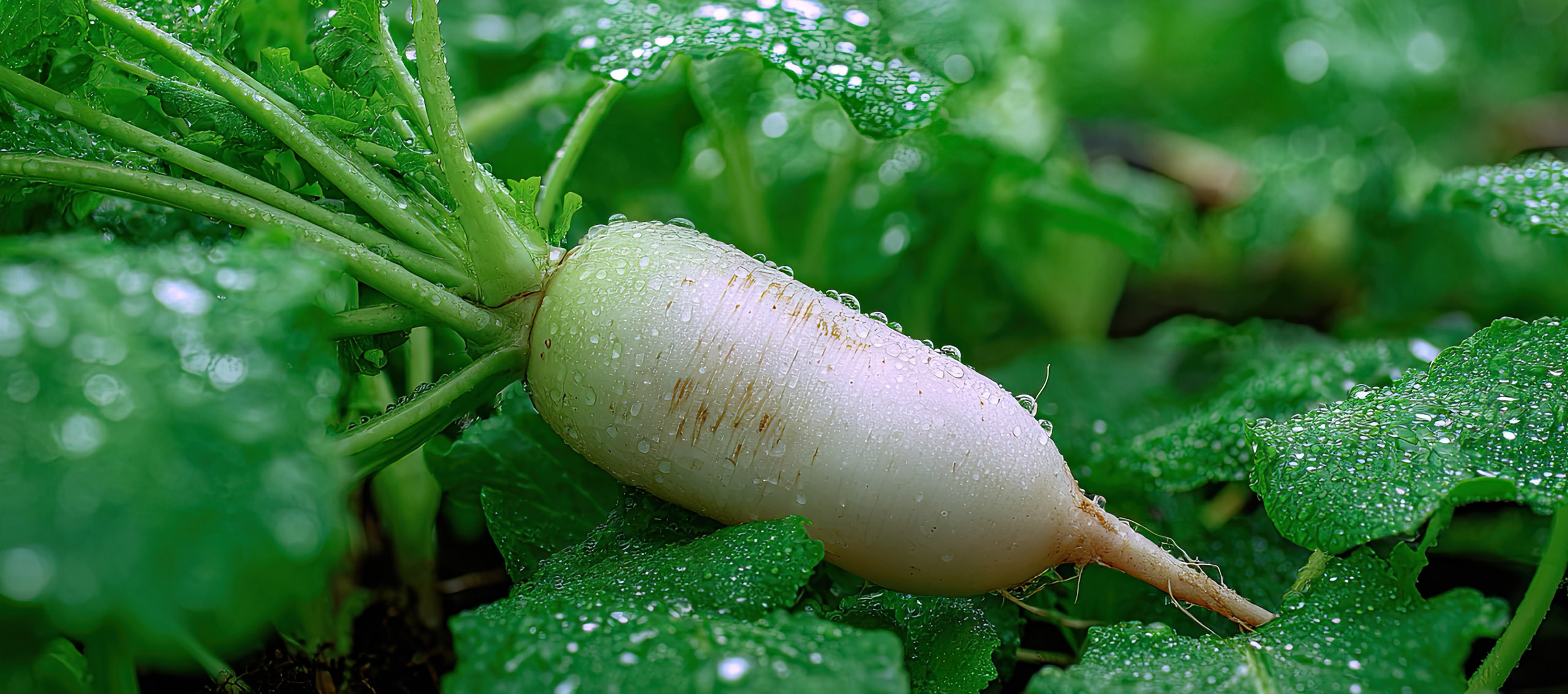
Daikon Radish: The Bio-Driller for Compacted Soils
Daikon radish (Raphanus sativus) is a brassica that’s revolutionizing no-till farming in Florida. Its massive taproot acts like a natural plow, breaking through hardpans without mechanical disturbance.
Planting and Management
Broadcast seeds in early fall (September-October) at 8-12 pounds per acre. Daikon germinates quickly in warm soil (above 45°F) and grows rapidly, reaching 2-3 feet tall with roots penetrating 2-6 feet deep. It tolerates light frosts but thrives in Florida’s winters. No inoculation needed — it’s not a legume.
Terminate by mowing or rolling in late winter/early spring before seed set to avoid volunteer issues.
Benefits for Soil Health, Carbon Sequestration, and Nutrient Cycling
Daikon radish “bio-drills” the soil, alleviating compaction. As the taproot decomposes, it leaves channels that enhance drainage and root penetration for subsequent plantings.
Regarding carbon sequestration, the radish’s bulky tops provide biomass. And decaying roots contribute significantly to the addition of organic matter. Brassicas like daikon can sequester carbon, storing it in subsoil layers for longer-term stability.
Nutrient cycling is where daikon shines as a scavenger. It uptakes excess nitrogen, phosphorus, and sulfur from deep profiles, preventing leaching — vital in Florida’s rainy season. Upon decomposition, these nutrients release slowly, drastically reducing fertilizer needs. It also suppresses soil-borne diseases and nematodes through biofumigation (releasing natural compounds).

Hairy Vetch in Cool Seasons: The Winter Nitrogen Powerhouse
Hairy vetch (Vicia villosa) is a cold-hardy winter annual legume widely used as a cover crop across the Southeast. Unlike warm-season legumes, hairy vetch thrives in Florida’s cooler months, making it an ideal choice for fall and winter soil building when microbial activity slows, and bare soil is most vulnerable.
In North and Central Florida, hairy vetch performs especially well during true winter conditions (40–65°F), providing living ground cover, biological nitrogen fixation, and erosion protection when many other plants are dormant.
Planting and Management
Plant hairy vetch in fall, typically October–November in Zones 8–9 and November–December in warmer Zone 10 microclimates. For food forest or garden-scale systems, sow densely to maximize ground coverage.
Always inoculate seed with the appropriate Rhizobium leguminosarum inoculant to ensure effective nitrogen fixation, especially in soils where vetch has not been grown previously.
Hairy vetch establishes slowly at first, focusing on root development through winter, then accelerates growth in late winter and early spring. It typically reaches peak biomass in 90–120 days, often flowering in March–April in Florida.
For management:
- Use as a standalone winter cover or mix with cereal rye or oats for improved structure and weed suppression.
- Terminate before full seed set by mowing, crimping, or chopping for mulch.
- Allow residue to decompose for 2–4 weeks before planting nitrogen-sensitive crops.
Benefits for Soil Health, Carbon Sequestration, and Nutrient Cycling
Hairy vetch is one of the most effective biological nitrogen fixers used in regenerative and permaculture systems. Well-established stands significantly reduce the need for synthetic or imported fertility.
For soil health, its deep, fibrous root system:
- Improves soil aggregation and porosity
- Feeds winter soil microbes through root exudates
- Prevents compaction and erosion during heavy winter rains
In terms of carbon sequestration, hairy vetch produces 3–5 tons of above-ground biomass per acre under good conditions. This high-carbon residue, combined with nitrogen-rich tissues, supports long-term soil organic matter formation when incorporated or left as surface mulch.
Nutrient cycling benefits include:
- Slow-release nitrogen availability for spring crops
- Enhanced phosphorus availability through microbial interactions
- Improved nutrient retention, reducing winter leaching losses common in sandy Florida soils
When used before heavy feeders like corn, squash, tomatoes, or young food forest plantings, hairy vetch acts as a natural fertility bridge between winter and spring.

Conclusion: Invest in Florida’s Soil Future
Adopting winter cover crops, such as perennial peanut, clover mixes, daikon radish, and hairy vetch, is a smart strategy for building soil in Florida. They enhance carbon sequestration, promote nutrient cycling, and yield long-term dividends in productivity and sustainability. Start small — try a clover mix in your garden this winter — and scale up from there. Your soil (and the planet) will thank you.
Copyright © 2026 Fruitful Food Forestry & Lauren Lynch. No portion of the original content on this website may be reproduced, in any language, without express written consent.
Gardeners just wanna have fun.
We’ve got you covered…



Leave a Reply
Your email is safe with us.